Last year, the country's defence budget was $175 billion.

As remarkable as DRDO's contribution in containing and treating COVID-19 has been, its success over the last 15 months has been in its primary role of developing conventional defence equipment and technologies.
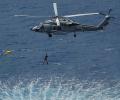
India, Japan and the Unoted States on Friday kicked off their marine war games, Malabar Exercise, close to the South China Sea as they focus on deeper military ties and greater interoperability amid rising tensions in the region.

While trying to persuade North Korea to give up its provocative actions, engaging China is the first hurdle that world leaders will have to deal with, says Rajaram Panda.

When a Chinese warship entered Japanese waters, the Indian commander called on China to maintain discipline at sea. Dr Rajaram Panda explains the significance of the Malabar exercises between India, Japan and the US.

With tensions between China and Taiwan rapidly increasing, the tone of China's official media has also become progressively more strident, observes former senior RA&W officer and China expert Jayadeva Ranade.

'Today the Chinese think they can slap India, and there will be no consequences.' 'They must be made to feel the consequences through any and all means,' says Rajeev Srinivasan.

Marking a breakthrough in the protracted talks in the French Rafale jet deal, Prime Minister Narendra Modi announced on Friday that India will purchase 36 of these fighter planes that are ready to fly, citing critical operational requirement of the Indian Air Force.

It is the country's second aircraft carrier, after the Liaoning, and the first to be made domestically.
'Make in India is one of the priorities identified by Minister Sitharaman and this is our great weakness,' warns Vice Admiral Premvir Das.
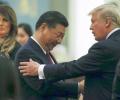
'While many Chinese policy makers dismiss the political, economic and technological component of US-India relations, they express caution on the defence-related ties which also happens to be a major driver in US-India relations,' explains China expert Srikanth Kondapalli.

'No matter how severe sanctions the UN security council imposes on North Korea, the impact of the sanctions would depend on how faithfully they are enforced by China,' says Dr Rajaram Panda.

The Theatre-level Readiness and Operational Exercise was conducted to test combat readiness of the combined fleets of the Navy, the Air Force, the Army and the Coast Guard.

North Korea on Wednesday test-fired a ballistic missile towards the Sea of Japan.
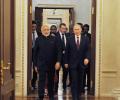
There could be significant announcements about India's purchase of Kamov-226T helicopters, S-400 air defence missile systems, and the long-delayed contract for joint development of the Fifth Generation Fighter Aircraft.

Govt wants domestic production so as to save foreign currency.

'China, which had earlier blockaded New Delhi's bid to join the Nuclear Suppliers Group by citing the nuclear non-proliferation law, finds itself in an awkward position and international isolation.' 'India needs to pursue a policy of mediation between China and the Southeast Asian countries for regional security,' says Srikanth Kondapalli.
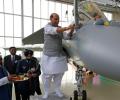
'We spent Rs 59,000 crore on acquiring 36 Rafales and we do not know if we will ever use them. The chances are that we never will,' argues Aakar Patel.

The success of Anil Ambani's ambitious defence plan will depend partly on whether he can persuade government officials and international partners that he can build sophisticated equipment and partly on whether the PM can get India's notoriously slow procurement process to work, say Paritosh Bansal, Sanjeev Miglani and Promit Mukherjee.
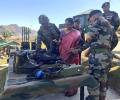
'We must look at the entire question of military preparedness anew, taking into account the new realities,' says Vice Admiral Premvir Das (retd).

With the United States delivering an increasing share of India's arms imports, New Delhi must work with it to retain control of our regional waters
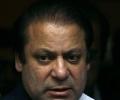
Prime Minister Nawaz Sharif sees his victory in Pakistan's election as a mandate for peace with India, saying an arms race between the two countries must end and they should settle their dispute over Kashmir.
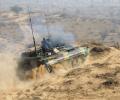
'Should the two armies clash in a conventional battlefield, the advantage will pass more and more to the Indians as the battle progresses,' says Brigadier S K Chatterji (retd).

'With the recent challenging of the notion of the Indian Ocean Region being India's strategic backyard, China is gradually upping the ante in the maritime realm around India.'

'The India-France relationship has been that of the elites of two countries, who appreciate each other's philosophical traditions -- whether it is ancient Indian civilisation and Sanskrit texts or the French tradition of Rene Descartes, Albert Camus, (Jean-Paul) Sartre... This is a drawback. It doesn't create the buzz, the excitement necessary for a relationship. We need more people-to-people contact, especially among students,' says former Ambassador to Paris, Rakesh Sood.

Rajeev Srinivasan on the disastrous after-effects of a made-up spying incident

The chairman of one of India's biggest industrial groups, Larsen & Toubro Ltd sees little sign of a recovery in Asia's third-largest economy,
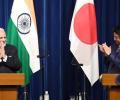
'Relations between India and Japan are robust and devoid of either shadow of history or any irritant.' 'In fact, there is plenty of warmth and goodwill earned over history. There are no negatives but only opportunities,' notes Dr Rajaram Panda.

'The only credible explanation for the niggardly approach to defence expenditure must be that the government does not expect a war.' 'But wars can happen when you don't expect them, and re-arming at the last minute is not possible,' says T N Ninan.

There's still little indication of forward movement in Indo-US defence relations.

Beyond the British and Russian strands interwoven into the Indian Navy's equipment profile and the strong drive towards indigenisation evident today, its future in aircraft carriers appears increasingly linked with America.
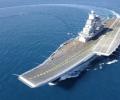
INS Vikramaditya is not the only thing on Defence Minister AK Anthony's agenda during his current visit to Moscow. Also on the anvil is the Fifth Generation Fighter Aircraft joint development project which, if finalised and signed, could emerge as India's largest joint defence programme costing around 11 billion dollars, reports Nandan Unnikrishnan.
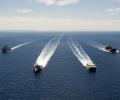
In the lead up to this week Indo-US Strategic Dialogue, for which United States Secretary of State, John Kerry, will be coming to Delhi, the Indo-US defence engagement is even more intense than usual.

The most remarkable feature of these warships is that, tonne-for-tonne, they are not only one of the world's most heavily armed but also one of the cheapest.

Tragic as it is, the submarine accident is more tactical in nature and it is the deeper strategic malaise across the board -- political, economic, security, judiciary, bureaucracy and even the media -- that has led to this dark mood of gloom and despondency, says Commodore (retd) C Uday Bhaskar.
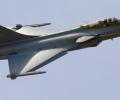
'There is no secrecy clause to the price (of the aircraft).' 'There can be secrecy on the capability of the nuclear payload of aircraft and things like that, but the price is hardly a secret.'

Tailored luxury experiences with the most minute of details charted out for discerning travellers is the way forward, says Nikita Puri.

"A mere 5-6 per cent of defence budget for R&D is inadequate to meet the aspirations of India's defence needs especially when China spends about 20 per cent of their defence budget for R&D," said the DRDO chief.

The India that needs strategic alliances, defence cooperation and engaging meaningfully with neighbouring countries is quietly moving ahead with confidence, says Tarun Vijay

The bogey of the 1962 defeat must be laid to rest with a finality that is unquestionable. The myth of Chinese invincibility is a tall tale that belongs to an era gone by, says Vivek Gumaste.
